Insecticide treated bed nets (ITNs) can help save lives by keeping people safe from mosquito bites while they sleep. You can donate bed nets to people living in malaria-endemic countries to help keep them safe from this disease. The links below give you access to support charitable organizations fighting to eradicate malaria and/or send bed nets where they are needed most. Thank you for reading!
Roll Back Malaria Partnership (RBM)– established in 1998 to coordinate donor’s efforts to fight malaria. Coordination of governments, UN agencies, international organizations, and affected countries.
The Global Fund to Fight AIDS, Tuberculosis (TB), and Malaria– created in 2001 as an independent, international institution which provides financing and grants to countries to combat AIDS, TB, and malaria.
United States Government– involved in efforts to eradicate malaria since the 1950’s expanded its efforts to fight malaria in 2000 and is the largest government donor.
The President’s Malaria Initiative (PMI)– began in 2005 and led by the U.S. Agency for International Development (USAID) is the leader in implementation of malaria eradication efforts for the U.S. The PMI has expanded efforts and increased funding for many of the hardest hit areas of Sub-Saharan Africa.
Goals:
To reduce the incidence of malaria
To reduce the mortality rate by at least 90% by 2030
Eliminate malaria in at least 35 new countries
Prevent re-establishment of the disease in malaria-free countries
Actions:
Expanding access to these interventions:
Insecticide treated bed nets (ITNs)
Indoor residual spraying (IRS) with insecticides
Entomological monitoring
Intermittent preventative treatment in pregnancy (IPTp)
Diagnosis of malaria and treatment with artemisinin-based combination therapies
Seasonal malaria chemoprevention (SMC)
Existing Challenges:
Weak healthcare systems in affected countries
Limited access due to poor infrastructure
Combating counterfeit or substandard malarial treatments
Continuing research and development regarding insecticide resistance
U.S. reduction in funding from $984 billion dollars to a proposed $871 billion dollars in 2020
I have decided to focus my blog on Malaria in Sub-Saharan
Africa. More than one million people die from Malaria and between 300-600
million people suffer from the disease each year; 90% of these cases occur in
Sub-Saharan Africa (UNICEF, n.d.). Because malaria is a vector-borne disease
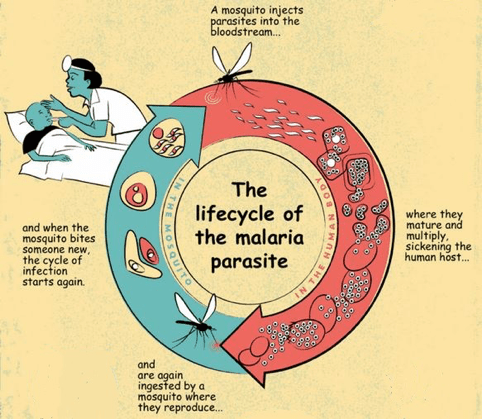
carried by mosquitos (Anopheles), the
risk factors are related to both humans, mosquitos, and the environment. Human
risk factors are health status (malnutrition & other illness), pregnancy, and
age (older individuals have greater immunity) (Protopopoff et al., 2009). Risk
factors related to mosquitos are insecticide resistance, rainfall (increased
rain increases mosquito lifespan and breeding capabilities), and availability
of breeding sites (Protopopoff et al., 2009). Environmental factors include
poorly constructed housing, poor drainage, poor access to healthcare and
temperature, 75-85 degrees is the optimal temperature for parasite development (Protopopoff
et al., 2009).
Malaria and poverty are historically intertwined, in 1995
countries with high rates of malaria showed income levels 67% lower than those
without malaria (Gallup & Sachs, 2001). Malaria also strikes at the development
of economies by reducing the amount of children that can attend school, not
only must they stay home due to illness but many children affected by malaria
will develop lifelong physical and/or mental impairments (UNICEF, n.d.). This only
contributes to the cycle of poverty in malaria endemic countries. Anti-malarial
drugs are available but the most effective are artemisinin-containing
treatments (ACTs) which cost $1-2 dollars per dose, this is ten times more
expensive that other malarial medications (UNICEF, n.d.). Costs related
directly to the disease such as testing, treatment, and premature death are
estimated at $12 billion per year (Centers, 2019). Poor infrastructure in
malaria endemic countries contributes to the propagation of the disease and
makes it more difficult to control. All of these factors add up to 1.3% suppression
of economic growth each year, many of these are already among the poorest
countries in the world (Shah, 2013).
Protopopoff, N., Van Bortel, W., Speybroeck, N., Van
Geertruyden, J. P., Baza, D., D’Alessandro, U., & Coosemans, M. (2009).
Ranking malaria risk factors to guide malaria control efforts in African
highlands. PloS one, 4(11), e8022.
doi:10.1371/journal.pone.0008022.
For this project I will be researching communicable diseases in Sub-Saharan Africa. My research will lead me to answer 4 questions regarding this topic:
What are the leading burdens of disease in this region?
What are the risk factors associated with this disease?
What are the costs and consequences of this disease on this region?
Who are the key players and what actions are being taken to address this disease?
Hello everyone! I am completely new to this scene and looking forward to learning from this experience! I am a global health science student looking to broaden my knowledge and perspective on the global health burden of communicable diseases. I’ll be adding information and my thoughts to this blog as I research my topic over the next several weeks.



 April's Blog